Scaled content abuse
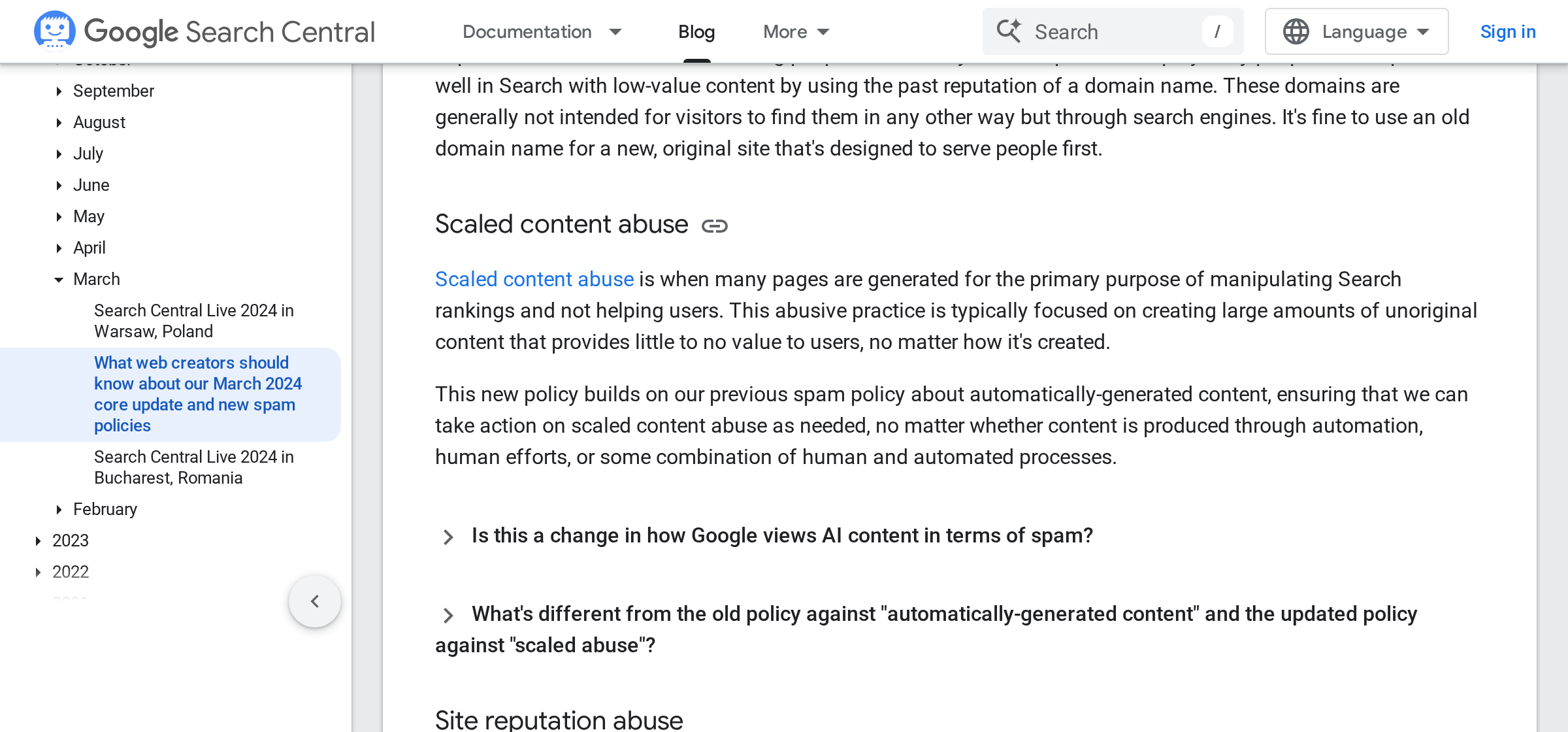
Scaled content abuse is a Google Search spam policy, announced on 5 March 2024, that treats mass-produced low-value pages as spam whether a machine, a person or both produced them[1][2]. It builds on the older policy against automatically-generated content and shipped with the March 2024 core update, which Google expected would cut low-quality unoriginal results by 40% and afterwards measured at 45%[3].
What the policy covers
Google's spam policies gained three entries in March 2024: expired domain abuse, scaled content abuse and site reputation abuse[1]. Scaled content abuse describes large amounts of unoriginal content generated for ranking rather than for readers, and the wording is deliberately indifferent to authorship, reaching automation, human effort and any mixture of the two[2]. Site reputation abuse, the practice of renting a trusted domain's ranking signals to third-party pages, took effect on 5 May 2024[4] and was tightened on 19 November 2024 so that first-party oversight no longer exempts the arrangement[5].
The March 2024 enforcement wave
Enforcement opened with manual actions rather than ranking changes. Originality.ai checked about 79,000 sites carrying MediaVine, Raptive or Ezoic advertising and found 1,446 of them, 1.9%, hit with a manual action, with estimated combined losses above 20 million visits a month[6]. A second pass over 30,614 URLs from 175 of those sites reported 151 with content its detector flagged as machine-written and 51, about 30%, at 95% or more[7]. Google published the 40% target the same week and reported 45% when the rollout closed on 19 April 2024[3].
Whether AI text is penalised
Google has held since February 2023 that appropriate use of AI or automation does not breach its guidelines, and that its ranking systems reward quality rather than a production method[8]. The 2024 rewrite keeps that line: the offence is publishing at scale to manipulate rankings, so a hand-written page farm is as liable as a generated one and a single well-sourced page written with a model is not[2].
How much machine text reaches results
Publishing volume and retrieval diverge sharply. Graphite classified a random sample of 55.4k Common Crawl URLs with three detectors and put primarily AI-generated pieces at 49.9% of everything published in the first quarter of 2026[9], yet measured 86% of articles ranking in Google and 82% of articles cited by ChatGPT and Perplexity as human-written[10]. A scan of AI Overviews across 29,000 queries in health, finance, law and politics classified 10.4% of cited documents as machine-written, rising to 12.8% for citations pulled from outside the top 100 organic results[11]. The rolling top-20 measurement shows the March 2024 dip to 7.43% and a later climb to 17.31% by September 2025[12].
References (12)
- What web creators should know about our March 2024 core update and new spam policies - Google Search Central Blog Archive
- What web creators should know about our March 2024 core update and new spam policies - Google Search Central Blog Archive
- New ways we're tackling spammy, low-quality content on Search - Google blog
- What web creators should know about our March 2024 core update and new spam policies - Google Search Central Blog Archive
- Updating our site reputation abuse policy - Google Search Central Blog Archive
- Can Google Detect and Does it Penalize AI Content - Originality.ai Archive
- Can Google Detect and Does it Penalize AI Content - Originality.ai Archive
- Google Search's guidance about AI-generated content - Google Search Central Blog Archive
- Half of Articles Being Published Online Are Now Generated by AI - Graphite Archive
- AI-Generated Content Does Not Perform In Search - Graphite Archive
- 10.4% of AI Overview Citations are AI-Generated - Originality.ai Archive
- Amount of AI Content in Google Search Results - Ongoing Study - Originality.ai Archive
Last updated 2026-09-04. Written and maintained by Baseline Labs.
