E-E-A-T
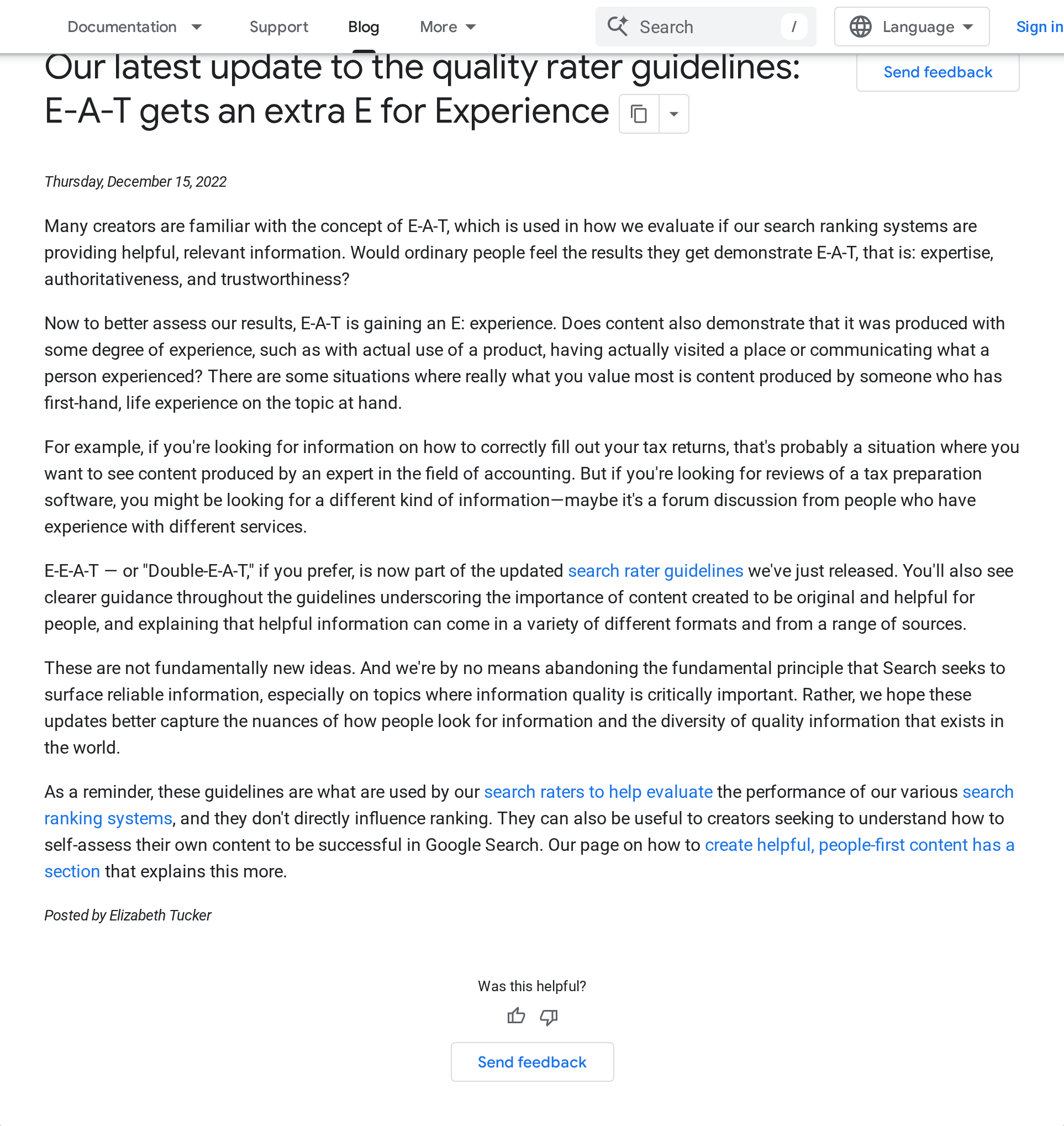
E-E-A-T stands for experience, expertise, authoritativeness and trust. It is the vocabulary Google's Search Quality Rater Guidelines give to human raters for judging page quality, not a score a page carries. E-A-T entered the guidelines in 2014[1], and the second E, for experience, was added on 15 December 2022[2]. The framework is widely borrowed in GEO writing as shorthand for what makes a source citable.
What the guidelines actually say
Google's own documentation describes E-E-A-T as a mix of factors its automated systems use to find helpful content, and states that a page need not demonstrate all four aspects: experience alone, or expertise alone, can be enough[3]. Of the four, trust is named the most important, with the other three feeding it rather than standing beside it as independent requirements[4]. More weight goes to pages on YMYL topics, those able to affect a reader's health, finances or safety[5].
Not a ranking factor
Google's Search Liaison, Danny Sullivan, said on 7 February 2024 that E-E-A-T is not a ranking factor and does not feed into other ranking factors[6]. The two statements are consistent: raters use the vocabulary to score sample results, and those scores are used to evaluate ranking changes, but no E-E-A-T value is computed for a URL[3].
The 2025 rater update
On 11 September 2025 Google added a chapter of rating examples for AI Overviews, matching the example format already used for featured snippets and knowledge panels[7]. The same revision also reworked the YMYL definitions[8]. Google described the revision as minor and said it made no change to the underlying rating guidance[9].
Evidence in AI answers
The causal evidence is thinner than the volume of advice suggests. A study presented at KDD 2024 found that rewriting content with generative-engine techniques, including adding citations and quotations from credible sources, raised a source's visibility in generative answers by up to 40% across a 10,000-query benchmark[10]. That is a content-shape result, not a proof that author bios or credentials drive citation. One vendor analysis puts a number on the gap, reporting pages ranked sixth to tenth with strong E-E-A-T signals cited 2.3 times more often than top-ranked pages with weak authority signals[11]. It is a single vendor measurement.
References (11)
- The Complete Guide to the Basics of Google's E-E-A-T - Bruce Clay Archive
- Our latest update to the quality rater guidelines: E-A-T gets an extra E for Experience Archive
- Creating helpful, reliable, people-first content - Google Search Central Archive
- Creating helpful, reliable, people-first content - Google Search Central Archive
- Creating helpful, reliable, people-first content - Google Search Central Archive
- Google Says EEAT Is Not A Ranking Factor Nor A Thing That Factors Into Ranking - Search Engine Roundtable Archive
- Google updates search quality raters guidelines, adding AI Overview examples, YMYL definitions Original
- Google updates search quality raters guidelines, adding AI Overview examples, YMYL definitions Original
- Google updates search quality raters guidelines, adding AI Overview examples, YMYL definitions Original
- GEO: Generative Engine Optimization, KDD 2024 Archive
- Google AI Overviews Ranking Factors: 2026 Guide to Winning Citations Archive
Last updated 2026-09-04. Written and maintained by Baseline Labs.
