Robots.txt
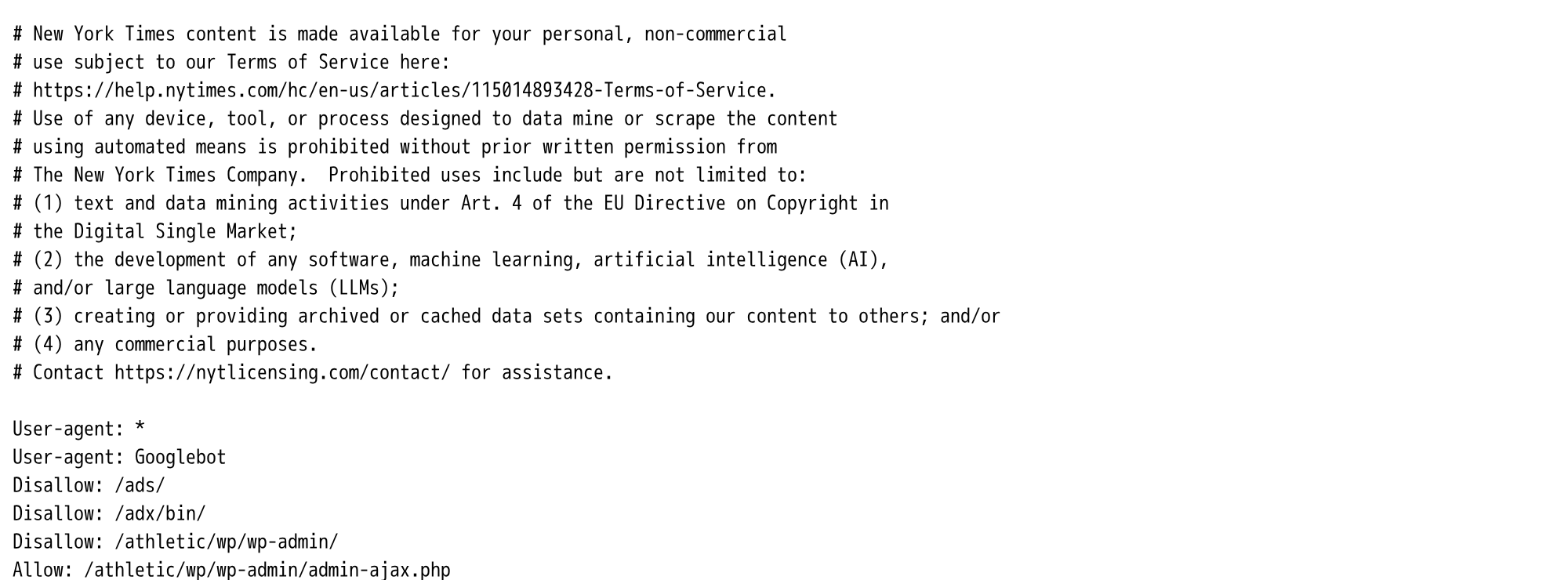
Robots.txt is a plain-text file at the root of a host that tells automated clients which paths they may fetch. RFC 9309, published in 2022, specifies and extends the convention Martijn Koster defined in 1994[1], and states in the same document that its rules are a request rather than access control[2]. Since 2023 the file has carried a second job it was never designed for: separating AI crawlers that collect training data from those that fetch a page live to answer one question, through tokens each operator invents and documents on its own.
Tokens the AI operators publish
No registry of user-agent tokens exists, so each operator names and documents its own. OpenAI runs GPTBot for training data and says a Disallow for it signals that a site's content should not be used to train foundation models[3]. Separate tokens cover search and advertising, while ChatGPT-User fetches a page because a person asked for it, a case where OpenAI warns that robots.txt rules may not apply[4]. Anthropic divides ClaudeBot, Claude-User and Claude-SearchBot along the same lines and states that its bots honour Disallow and Crawl-delay[5]. Perplexity documents PerplexityBot as a search-index crawler and says its Perplexity-User token generally ignores robots.txt[6]. Per-bot detail sits in the bot encyclopedia.
Google-Extended
Google added Google-Extended on 28 September 2023 as a control over whether a site's content helps improve Bard and Vertex AI generative APIs[7]. It now governs training of the Gemini models and grounding in Gemini Apps and Vertex AI, and Google states that blocking it does not affect a site's inclusion in Google Search and is not used as a ranking signal there[8]. The two controls are separate levers on the same crawl: Googlebot decides whether a page is indexed, Google-Extended decides whether the crawled text feeds Gemini training and grounding. Blocking it therefore leaves Search presence, AI Overviews included, untouched.
Compliance is voluntary
Nothing in the protocol enforces anything. A crawler can ignore the rules, spoof its identity or otherwise avoid detection[9], and Cloudflare reports AI crawlers making more than 50 billion requests a day to its network, just under 1% of all requests it sees, some of them disregarding no-crawl directives[10]. The first large-scale measurement of compliance, over 130 self-declared bots and 40 days of institutional web logs, found bots are less likely to comply with stricter directives, and that AI search crawlers rarely request the file at all[11]. Publishers have tightened the file fast. The Consent in Crisis audit of 14,000 domains found that within a year robots.txt came to fully restrict more than 5% of all tokens in the C4 corpus and more than 28% of its most actively maintained sources, with 45% of C4 restricted by terms of service[12]. See training data versus retrieval for why the two kinds of block have different consequences.
Saying what a crawl is for
Two efforts extend the file from who may crawl to what the crawl is for. Cloudflare's Content Signals Policy, announced 24 September 2025, adds a content-signal directive carrying yes or no values for three uses: search, generative answers and model training[13]. Its managed robots.txt already applied the policy to more than 3.8 million domains at launch[14]. The IETF AI Preferences working group is standardising the same idea as a vocabulary plus a set of attachment methods, robots.txt among them[15]. Both inherit the weakness of the original: a preference in a file is worth only what the reader chooses to give it. Compare llms.txt, which asks for attention rather than withholding it, and content licensing deals, which replace the request with a contract.
References (15)
- RFC 9309: Robots Exclusion Protocol Archive
- RFC 9309: Robots Exclusion Protocol Archive
- OpenAI crawlers - OpenAI developer documentation Archive
- OpenAI crawlers - OpenAI developer documentation Archive
- Does Anthropic crawl data from the web, and how can site owners block the crawler? - Anthropic support Archive
- Perplexity crawlers - Perplexity documentation Archive
- An update on web publisher controls - Google Archive
- Google's common crawlers - Google Search Central Archive
- LLMs.txt Tracking Study and Live Dashboard - Originality.ai Archive
- Trapping misbehaving bots in an AI Labyrinth - Cloudflare Archive
- Scrapers selectively respect robots.txt directives: evidence from a large-scale empirical study
- Consent in Crisis: The Rapid Decline of the AI Data Commons - arXiv Archive
- Giving users choice with Cloudflare's new Content Signals Policy Archive
- Giving users choice with Cloudflare's new Content Signals Policy Archive
- AI Preferences (aipref) - IETF Datatracker Archive
Last updated 2026-09-04. Written and maintained by Baseline Labs.
